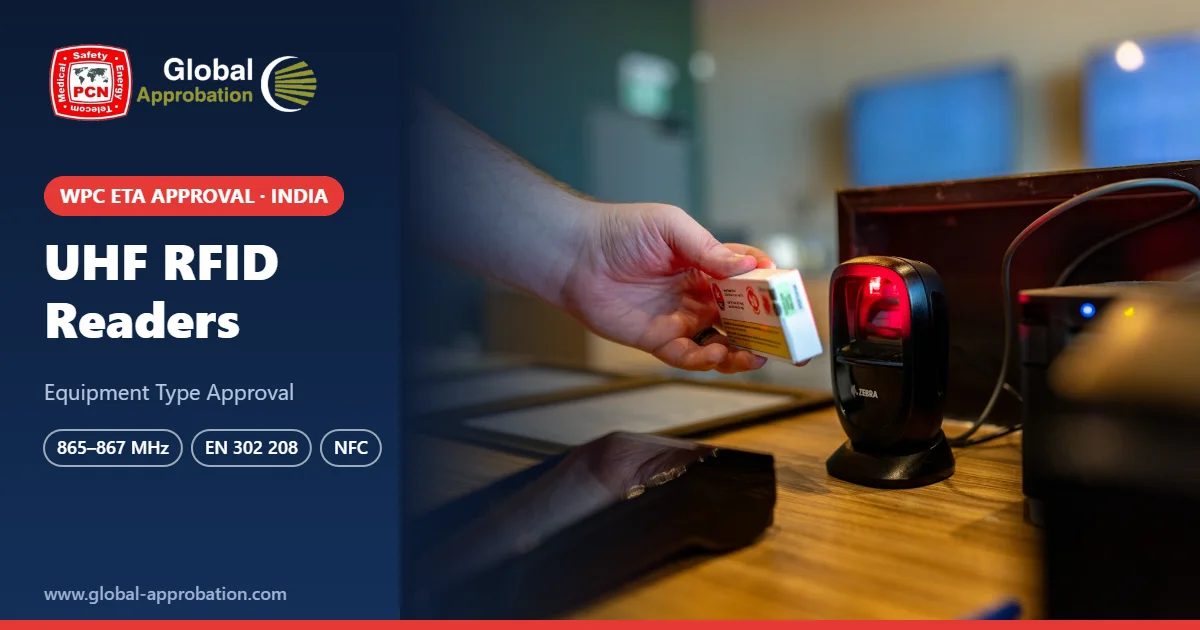
UHF RFID readers, handheld scanners and anti-theft gates used in retail, logistics and toll systems transmit in 865–867 MHz in India. Every reader model needs WPC ETA. This guide covers the bands involved, the RF test standards, the other Indian approvals that usually apply, and the mistakes that most often delay approval. For the full service, see our WPC ETA approval services.
Quick answer: Yes. India allows UHF RFID in the de-licensed 865–867 MHz band within its power limit, so readers qualify for ETA by self-declaration. The fee is Rs 10,000 per application and the ETA remains valid unless revoked.
📡 Do UHF RFID Readers Need WPC Approval?
Yes. India allows UHF RFID in the de-licensed 865–867 MHz band within its power limit, so readers qualify for ETA by self-declaration. Readers designed for the US 902–928 MHz band must be reconfigured, and tested, for 865–867 MHz before import.
📶 Radio Bands & Technologies
UHF RFID (865–867 MHz)
The Indian UHF RFID band. Tested to ETSI EN 302 208.
HF RFID / NFC (13.56 MHz)
HF readers and dual-frequency readers. Tested to ETSI EN 300 330.
Bluetooth / Wi-Fi (handhelds)
Handheld readers usually add Bluetooth or Wi-Fi for data transfer, tested to ETSI EN 300 328.
🔬 RF Test Standards & Reports
WPC needs an RF test report for every transmitter in the product. Reports are typically prepared against the harmonised ETSI standards below, at an ISO/IEC 17025-accredited lab, with the firmware set to India’s bands and power limits.
- ETSI EN 302 208 — UHF RFID 865–868 MHz
- ETSI EN 300 330 — 13.56 MHz HF/NFC
- ETSI EN 300 328 — Bluetooth/Wi-Fi on handhelds
🧾 Other Approvals for UHF RFID Readers
WPC ETA covers only the radio. Depending on the product, these approvals usually run alongside it:
- BIS CRS for adapters and batteries: Handheld readers with Li-ion batteries and readers shipped with adapters need those parts registered under BIS CRS.
- Passive tags: Passive RFID tags do not transmit on their own and are generally not treated as transmitters needing ETA.
🛠️ Step-by-Step WPC ETA Process
- Map every radioList each transmitter in the uhf rfid readers with its band, technology and maximum output power.
- Check India settingsConfirm firmware limits channels and power to the Indian de-licensed bands.
- RF testingTest each radio to the applicable ETSI standard at an ISO/IEC 17025-accredited lab, or check that existing reports cover the Indian settings.
- Register on SARAL SancharCreate the applicant profile (Indian entity or authorised Indian representative, with GST, PAN and IEC details).
- File the self-declarationUpload the RF test report, technical documents and authorisation, and pay the Rs 10,000 fee.
- Download the ETAUnder DoT’s September 2024 OM, the ETA can be downloaded once the application is successfully submitted.
📄 Documents Required
- RF test report covering every radio in the product
- Technical specifications: frequency bands, technology and maximum output power for each radio
- User manual and product photographs or label artwork showing the model number
- Authorisation from the manufacturer, where an Indian representative applies
- Applicant registration details on SARAL Sanchar (GST, PAN, IEC)
⚠️ Common Pitfalls for UHF RFID Readers
- US-region (902–928 MHz) readers imported without a firmware lock to 865–867 MHz.
- Test report from the ETSI 865–868 MHz range that does not show the Indian 865–867 MHz settings.
- Fixed reader and antenna sold separately but approved as one.
- Handheld’s Bluetooth and Wi-Fi left out of the RF report.
❓ Frequently Asked Questions
Can I import a US-band RFID reader?
Only if it is reconfigured and tested for 865–867 MHz. A 902–928 MHz reader cannot be used in India.
Do RFID tags need WPC approval?
Passive tags generally do not. Active tags with their own transmitter do.
Is EN 302 208 accepted for India?
Yes, as the basis for testing, provided the report shows operation within 865–867 MHz.
How much does WPC ETA cost and how long is it valid?
The SARAL Sanchar fee is Rs 10,000 per application, and DoT states that an ETA is valid for life unless revoked by the WPC Wing. Testing costs are separate.
How long does WPC ETA by self-declaration take?
Once the RF test report is ready, the application is filed on SARAL Sanchar and the ETA can be downloaded after successful submission and fee payment. Most of the time goes into testing.
WPC ETA for UHF RFID Readers — Handled End to End
Global Approbation maps your radios, coordinates RF testing, files on SARAL Sanchar and manages the related BIS and DoT approvals, so your UHF RFID readers can clear customs without delay.
Talk to Our WPC Team WPC ETA Services